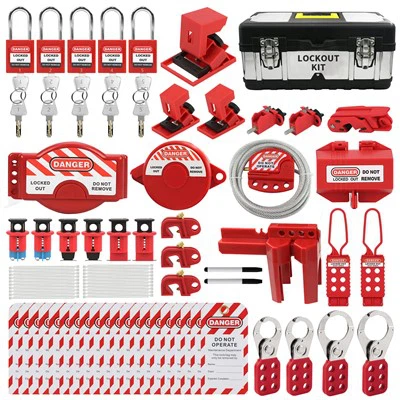
In the course of daily production and operational activities, incidents involving electrical energy leakage or the misoperation of electrical equipment occur with some frequency. These pose significant risks to the health and safety of personnel and disrupt the normal functioning of enterprises. To safeguard the safety of equipment operators, it is imperative to isolate all electrical, pneumatic, and hydraulic power supplies and implement a lockout/tagout procedure on the equipment.
Lockout refers to the procedure of disconnecting power sources and installing locks to prevent their reconnection. To safeguard equipment operators, all electrical, pneumatic, and hydraulic power sources must be disconnected, and equipment must undergo lockout and tagout procedures. Tagout denotes the process of affixing hazard warning labels to power sources, indicating that equipment must not be used until the warning labels are removed. The Occupational Safety and Health Administration (OSHA) standard requires that equipment undergo lockout and tagout procedures prior to any installation or preventive maintenance work.
The function of the danger warning sign is identical to that of a lock, and it shall only be used when a lock cannot be fitted to the isolation device. The warning sign must be secured to the isolation device using a warning sign strap or equivalent device, and must display the operator's name and any other information required by the company. The warning sign must be weather-resistant and capable of withstanding the harsh climatic conditions and extreme environments to which it is expected to be exposed.
Lockout/Tagout Application Scenarios
Lockout/Tagout applies in the following situations:
• When equipment does not require power during task execution
• Where there is a risk of entanglement or injury from moving machinery
• When bypassing or removing machine guards or other safety devices
• When clearing jammed equipment
• Where energised equipment poses an injury hazard
Lockout/Tagout Procedure
Lockout and tagout procedures do not themselves disconnect the power supply to machinery or its electrical circuits. The Occupational Safety and Health Administration (OSHA) provides standard procedures for locking and tagging equipment. Lockout and tagging operations are only performed after the equipment has been shut down and tested. A typical company lockout/tagout procedure is as follows:
1. Notify all relevant personnel that a lockout/tagout operation is required. The notification must include the reason for the lockout/tagout and its anticipated duration.
2. If the equipment is running, shut it down according to normal procedures.
3. Operate the energy isolation device to isolate the equipment from all energy sources. Stored energy in springs, elevated mechanical components, and capacitors must be dissipated or restrained by blocking, discharging, or other appropriate methods.
4. Apply the lockout/tagout to the energy isolation device using designated locks and hazard warning labels. Refer to Figure 3.
5. After confirming no personnel are exposed, operate the normal control devices to verify the equipment is inoperable and all energy sources are isolated.
6. Inspect the equipment using appropriate test instruments to verify all energy sources are disconnected. For multi-phase electrical systems, test each phase individually. At this point, the lockout/tagout procedure is complete.
Except in emergencies, no person shall remove a lockout/tagout device unless personally authorised by the installer. In emergencies, only the supervisor may remove the device after notifying the lockout/tagout personnel. The list of company rules and procedures must be distributed to authorised personnel and any individuals potentially affected by lockout/tagout operations.
When multiple electricians are required to work on the same equipment, each electrician must affix an independent lockout device to the energy isolation device. Multiple lockout devices (padlocks) must be used, as energy isolation devices typically cannot accommodate multiple lockout devices simultaneously. A padlock constitutes a multiple lockout device.
OSHA Requirements for Lockout/Tagout Operations
Lockout/tagout procedures must comply with OSHA 29 CFR 1910.147 Hazardous Energy Controls (Lockout/Tagout) and company regulations. Except in emergencies, lockout/tagout devices may only be removed by the installer. In emergencies, only authorised personnel (trained in standard lockout/tagout procedures) may release lockout/tagout devices. Tagging labels must be manually affixed, clearly legible, self-locking in design, and resistant to accidental detachment. Locking devices and tagging labels must be robust and durable, capable of withstanding damage from environmental and operational conditions. Written operating procedures must be established for each piece of equipment within the facility.
HiLink is your one-stop safety lockout tagout solution expert!