A model number tells us which family of breaker you have. It does not tell us whether our device will actually sit on it.
Breakers are easy to photograph. Lockout devices are not easy to guess. If we send the wrong one, you find out with the panel already open and the line already down. So we ask for a picture before we quote. It takes less time than reading this article.
A Model Number Only Tells Us Half the Story
Part numbers are written down by people, which means they arrive with pieces missing. Someone reads a series name off a panel schedule, types it into an email, and the suffix that separates a solid toggle from a drilled one stays behind on the desk.
Then there is the part nobody warns you about. Series names outlive their parts. A breaker family can stay in the catalogue for years while the moulding underneath it changes. Same label, different shape. If your panel was built in a different year from the one we are picturing, we can both be right and still be describing two different objects.
The last one is rebadging. It is common enough for the same breaker to leave one factory and turn up under more than one brand. The label tells you who sold it. It does not tell you what is underneath.
None of this is a reason to distrust your paperwork. It is just why a photo is faster than an email thread about suffixes.
What We Look At in the Photo
We are not studying your panel. There are four things we check, roughly in this order.
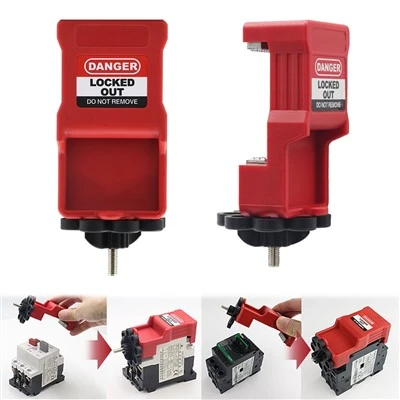
Is there a hole through the toggle? Breakers with holes take a pin-type device, where two pins pass through the toggle and the body clamps around it. Breakers without holes take a clamp-on body that grips from the sides with a thumb screw. Choose wrong and the device either will not mount or will not stay put.
How many levers move together? A single-pole breaker has one toggle. A single-pole-plus-neutral has two toggles tied by a factory link, and a body built for one toggle will not span the pair. Three-pole is wider again. We need the lever count before we pick a body length.
The next two are the ones buyers do not think to mention.
Clearance is the usual culprit. A toggle sitting behind a dead-front, with breakers tight on both sides, can leave less room than a clamp body needs to seat flat. You will not notice it looking at the breaker. You notice it when the device is in your hand and the panel door will not close.
Then there is the question of what you are actually isolating. On a DIN-rail board, the breaker in the photo is usually the isolation point. In an industrial panel it often is not. There is an upstream switch, or a plug, and the breaker sits downstream of it. Locking the wrong one is worse than locking nothing, because it looks like the job is done.