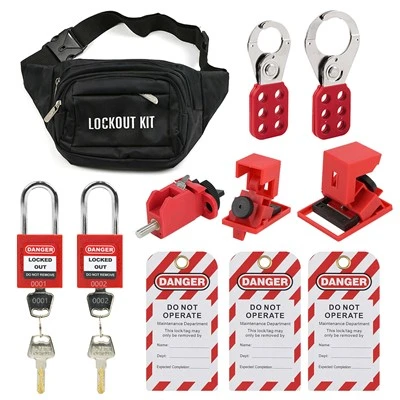
In industrial production, accidents of personal injury and damage to equipment due to accidental start-up of equipment, incomplete energy release or chaotic operation are common in hazardous operation scenarios such as equipment maintenance and repair. According to the the International Labour Organization, over 65% of accidents caused annually by poorly maintained equipment worldwide are directly related to energy isolation failures. By implementing standardized safety management processes, the accident rates can be reduced by more than 80%. As the core equipment in the field of industrial safety, safety lock has constructed up the safety barrier covering the whole process of hazardous operation through the synergy of five core components, thus realizing the goal of ``zero risk"operation.
Energy Isolation Lock: The "First Line of Defense" Against Physical Isolation Hazards
Energy isolation locks are a core component of the toolbox. Its function is to physically disconnect the device from the energy source completely, preventing the device from accidentally starting or generating residual energy during operation. According to energy type, electrical isolation locks can be divided into the following three categories:
1.Electrical Isolation Locks: Blocks current access.
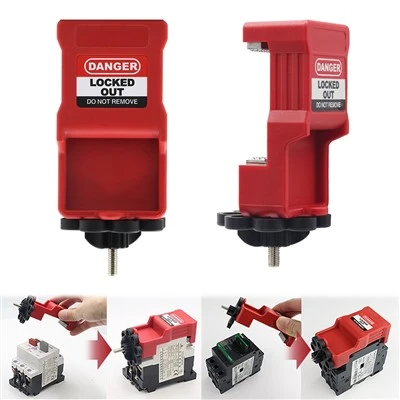
Circuit breaker lock: Lock circuit breaker switch directly in distribution boxes or equipment control cabinets to prevent accidental closure from causing electrocution or equipment startup.
Application Scenarios: Electrical maintenance, distribution system maintenance, high voltage equipment operation.
Innovative design: Some locks incorporate a voltage sensing feature that alerts when the device is not completely off to prevent charging.
Case study: a car manufacturer used circuit breaker to lock power switches during robot maintenance welding, reducing the incidence of electrocution from 3 to 0 per year.
Plug Locks: Lock equipment power plug to prevent accidental plug-in.
Advantages: Suitable for maintenance of mobile equipment (such as power tools, portable compressor, etc.), simple operation and low cost.
Data: Statistics from one construction site show a 70 70% in equipment damage accidents due to accidental insertions after the use of blockages. Valve Isolation Locks: Controlling Fluid Media
Ball Valve Locks/Butterfly Valve Locks: Prevent the valve from opening or closing accidentally by locking the valve handle or rotating shaft. Suitable for gas-liquid pipeline systems.
Application Scenarios: Chemical pipeline maintenance, gas system maintenance, water treatment equipment operation.
Standard: Seats must withstand more than 1.5 times the valve's maximum operating torque to ensure no deformation during long-term use.
Case study: a petrochemical company used ball valve lock to isolate steam pipeline in reactor, reducing maintenance cycles by 30% and eliminating media leakage.
Gate Valve Locks: Designed for gate valves to prevent accidental valve operation by locking the stem or handwheel.
Features: Suitable for high pressure, large caliber valves, locking material must possess high strength and corrosion resistance.
Advantages: The valve failure rate can be reduced by 95% when the gate valve is locked during steam pipeline maintenance.
3. Mechanical Isolation Locks: Fixed Moving Parts
Chain Locks/Cable Locks: These chain or cable encircle the moving part of the device (such as drive shafts and pulley) and hold it in place to prevent accidental rotation.
Application Scenarios: Maintenance of large mechanical equipment such as press, press and conveyor belts.
Innovations: Some locks incorporate tension sensors that automatically alert when the chain is loose to ensure effective isolation.
Case study: A Toyota plant used chain locks to secure punch sliders, avoiding breakdowns during maintenance.
Pin Locks/Stops: These locks are inserted into holes or gaps in moving parts of the device to prevent movement.
Strengths: Suitable for isolation of closed spaces or irregular shaped parts, flexible operation.
Data: The mechanical factory reduced accidental equipment start rate by 80% after using padlock.
ii. Warning Signage System: ``safe language"for Visualized Management
warning signage system uses tools such as high-visibility tags and fluorescent bands to clearly display the state of the equipment, operational risks and operating procedures, forming a glance"safety management network.
1. Multilingual Warning Labels: delivering key messages
Content requirements: Labels must include information such as "hazard type (e.g. electric shock, high pressure, high temperature)," "cause of isolation," "person responsible for maintenance," and "release conditions."
Standards: comply with OSHA or ISO 7010 standards and use internationally recognized symbols (e.g. "do not close", "under maintenance").
Innovations: Some tags incorporate RFID chips or QR codes that allow users to scan devices' maintenance histories with their phones, lock personnel information and support audit traceability.
Case study: The adoption of smart labelling by a multinational chemical company resulted in a 50% increase in the efficiency of label management and a 100% per cent audit pass rate.
2. Fluorescent Marking Strips: delineation of safe areas
Features: Use fluorescent strips (e.g. yellow, red) to indicate repair areas, hazard boundaries or energy isolation points to improve field visibility.
Application Scenarios: High altitude operation, confined space operation, pipeline maintenance, etc.
Strengths: Wear-resistant, corrosion resistant, can be used in -40°C to 80°C environment, service life of more than 3 years.
Data: Incidents of accidental entry into hazardous areas were reduced by 90% after fluorescent tagging tape was used at construction sites.
III. Verification and Testing Tools: 'Double insurance' to ensure isolation is effective
Verification and testing tools are used to confirm that equipment is completely isolated and has no residual capacity, a key step to avoid "false isolation."
1. Voltage Tester: Confirm electrical isolation
Function: check whether the power supply of the equipment is completely disconnected, prevent live work.
Requirements: The measuring range must include the rated voltage of the equipment (e.g. 0-1000V) and have a CAT III/IV safety rating (applicable to industrial environments).
Innovations: Some testers integrate "contactless" detection, which uses an induction electric field to determine whether a device is electrified without directly touching a wire.
Case study: A utility that uses contactless voltage tester has a 40% improvement in maintenance efficiency with no risk of electrocution.
2. Pressure Gauge and Pressure Relief Valve: confirm Fluid Isolation
Pressure Gauge: Monitor pressure inside piping or vessel in real time to ensure zero pressure prior to repair.
Accuracy Requirements: Error shall not exceed ±1% and the measuring range shall be 1.2 times the maximum working pressure of the equipment.
Pressure Relief: before repair, drain media (such as steam, compressed air) from the pipe to prevent residual pressure from causing a splash or explosion.
Application: Maintenance of chemical reaction vessels, boiler systems and air conditioning/refrigeration equipment.
Data: A pharmaceutical company used pressure relief valves to reduce pipeline media leaks by 92%.
IV. INTRODUCTION Lock Management Device: A Centralized "Intelligent Hub"
Locker management device adopts storage boxes, key management systems and other tools to realize centralized storage, distribution and tracking of lockers and prevent the loss or misuse of lockers.
1. Lockbox: Categorized Storage, quick access
Function: Store locks in different places according to type (electric lock, valve locks, mechanical lock), and specify the use instructions and applicable situations.
Innovations: Some storage boxes integrate electronic locks and access controls, allowing only authorized personnel to open them to prevent theft or misuse.
Advantages: By using lock storage boxes, manufacturers can reduced tool losses by 60% and double lock life.
2. Key Management System: Unique Control
Principle: Each lock has a unique key, which is kept by a maintenance worker to ensure "one lock, one key."
Upgraded Version: Smart key cabinets, which allocate keys by fingerprint or card swipe, and record retrieval time and personnel information.
Case study: after the implementation of a smart key cabinet in a nuclear power plant, the key management efficiency increased by 80%, eliminating all accidental misoperations.
V. Auxiliary Tools and accessories: the "Last Mile 'of safety in fine print
Auxiliary tools and accessories, while small, are critical details for ensuring security control throughout the process.
1. Insulation kit: protection against electrocution
Content: Insulated gloves, insulated shoes, insulated cushions, insulated rods, etc., for personal protection during electrical work.
Standard: Must be IEC 60903 or ASTM D120 certified, with a pressure rating to match the working voltage.
Case study: A power company reduced electrocution by 95 95% equipping maintenance crews with insulation tool kits.
2. Protective Glasses and face masks: Splash prevention
Function: To prevent metal shavings and chemical liquids from flying into eyes and face during maintenance.
Type: Collision glasses, gas mask, dust face shields, etc., selected according to operation risk.
Data graph: Eye injury accidents were reduced by 85% after protective glasses were implemented in a machining workshop.
Conclusion: Five Components working together to build a "Zero-Risk" Operational System
The five core components of the Safety Lock/ Disconnect Toolkit-energy isolation Lock, Warning signage systems, Validation Test Tool, lock management Device, Assistive Tools, and Accessories-build a comprehensive, all-encompassing safety barrier for hazardous operations through a collaborative mechanism of Physical Isolation + Visual Control + process verification + Intelligent Management + Details Protection. Its value lies not only to reduce accident rates, but also to push the company from ``passive security"to ``active security '', and to integrate safety culture into every stage of operation. In the future, with the integration of technologies such as the Internet of Things and artificial intelligence, the toolkit will become smarter and secure the industry.
 English
- English
- Français
- Deutsch
- 日本語
- Italiano
- Español
- Português
- русский
- Melayu
- Türkçe
- Eesti
- বাংলা
- România limbi
- O'zbek
- Malti
- فارسی
- українська
- dansk
- Svenska
- Indonesia
- Srbija jezik (latinica)
- اردو
- suomi
- Norsk
- Bai Miaowen
- slovenčina
- Nederlands
- íslenska
- bosanski
- Cymraeg
- Latviešu
- Polski
- Gaeilgenah Éireann
- Lietuvių
- Ελληνικά
- slovenščina
- عربي
- ไทย
- 한국어
- Kreyòl Ayisyen
- hrvatski
- हिंदी
- magyar
- Čeština
- Català
- עברית
- Việt Nam
- Български