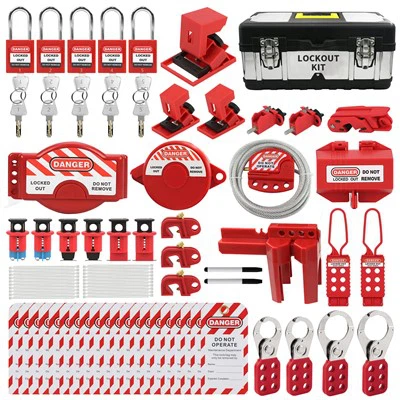
Lockout Tagout is not always the right solution.
Yes, exceptions exist, but it must be emphasized that these exceptions require careful evaluation to ensure they provide an equivalent level of protection to the lockout/tagout procedure.
Within the standards, several recognized exceptions may be used to protect employees from mechanical hazards as alternatives to strictly following lockout/tagout procedures. These measures include:
1.Effective machine guarding prevents employee access to hazardous areas of machinery or provides protection through controlled access mechanisms.
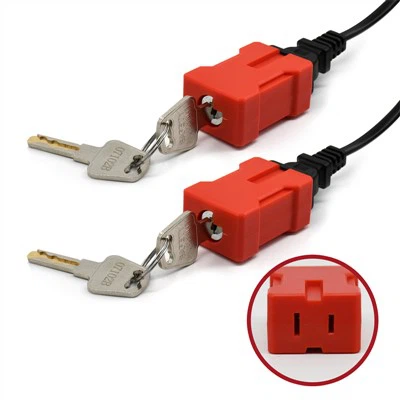
2.Equipment with power cords and plugs must be kept under operator control throughout maintenance procedures.
3.For power-dependent mechanical testing, positioning, or troubleshooting tasks, lockout devices may be "temporarily" released when testing or positioning can be performed from a safe distance.
4.Complies with the U.S. Occupational Safety and Health Administration (OSHA) "Minor Maintenance Exception" requirements.
What is OSHA's Minor Maintenance Exception?
1.The Minor Maintenance Exception is only an exception, not the primary rule. It should not be the preferred solution for machinery safety during maintenance or repair tasks, as it applies only under extremely specific conditions.
2.When utilizing this exception, processes must be strictly monitored and personnel operations reviewed to ensure proper implementation.
3.Limiting the "Minor Maintenance Exception" to a localized part of the overall energy control program helps effectively safeguard worker safety.
4.When invoking this exception, equivalent safety measures-such as lockout/tagout procedures-must be implemented to provide equivalent protection.
What is the Minor Repair Exemption under the U.S. Occupational Safety and Health Administration (OSHA)? What are its requirements?
The minor maintenance exemption provision of the U.S. Occupational Safety and Health Administration (OSHA) is contained in 29 CFR 1910.147(a)(2)(ii)(B), which states: "Minor tool changes and adjustments and other minor maintenance activities performed during normal production operations are exempt from this standard if they meet the following conditions:
Routine,
Repetitive
Maintenance activities that are an integral part of the operation of production equipment, provided that alternative safeguards are used during the operation to ensure effective protection."
The U.S. Occupational Safety and Health Administration (OSHA) primarily stipulates that minor maintenance activities must be performed during normal production operations, meaning while machinery or equipment is performing its intended production function. In short, this refers to the mode in which energized machinery or equipment operates to manufacture products or support production processes. Furthermore, minor maintenance activities must be an inherent part of normal production operations-indispensable to the continuous flow of the production process.
Examples of minor maintenance tasks performed during normal production operations include:
Clearing jams
Lubricating mechanical components
Adjusting dials
Inspecting specific machine parts
Removing waste material
Typically, minor maintenance tasks do not involve extensive disassembly, heavy maintenance, multiple component replacements, equipment commissioning, or annual maintenance-related activities.