Most people focus on the same key points when it comes to Lockout/Tagout (LOTO): isolating the power supply, locking and tagging, and verifying the status before maintenance. However, in real-world industrial settings, many lockout procedures fail not because workers have forgotten these basic steps, but because they have overlooked hidden or subtle energy hazards and chosen the wrong locking devices.
For maintenance teams, contractors and plant safety managers, understanding these hidden risks is often more important than simply following a checklist.
1. Switching off the power supply does not mean that all energy has been eliminated
One of the most common misconceptions in the field of industrial safety is the belief that switching off the power supply ensures that equipment is safe.
In reality, hazardous energy may remain in various forms:
1. Residual hydraulic pressure
2. Air pressure trapped in pipes
3. Mechanical force generated by springs
4. Gravity acting on machinery at height
5. Rotational kinetic energy
6. Charge stored in capacitors
This is why many experienced safety professionals emphasise the 'lock, tag, test, verify' method, rather than simply locking the equipment.
For example, a conveyor belt may have been powered down and stopped, but the tensioned rollers may still continue to rotate; a hydraulic press may have been powered down, but residual pressure may still remain in the accumulator. In these situations, whilst locking devices can isolate the energy source, workers must still address this stored energy before commencing maintenance.
This is precisely where lockout procedures often fail: the issue lies not in isolation, but in energy verification.
2. Circuit breaker locking devices are often selected incorrectly
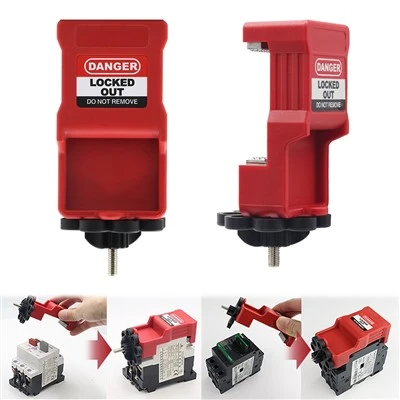
Electrical locking is the most common method used in LOTO applications, but circuit breaker locking devices are often incompatible with the equipment.
Different circuit breakers require different locking solutions:
Miniature circuit breakers (MCBs)
Typically used in:
1. Control cabinets
2. Distribution boards
3. Original equipment manufacturer (OEM) equipment
4. European/Asian equipment
Such equipment typically requires pin-insertion, pin-extraction or screw-clamp type miniature circuit breaker locking devices.
Moulded Case Circuit Breakers (MCCBs)
Commonly found in:
1. Industrial power distribution systems
2. Motor control systems
3. Large electrical cabinets
Such equipment typically requires larger, clamp-type circuit breaker locking devices.
Multi-pole circuit breakers
Commonly found in:
1. Three-phase equipment
2. Heavy machinery
3. Industrial electrical isolation points
If multi-pole systems are not locked out correctly, this may result in one phase being exposed whilst live.
In the control of hazardous energy, 'loose-fitting' locking devices are unacceptable. Correctly matching the equipment is a critical aspect of electrical isolation safety.
3. Collective locking is more than just adding locks
Collective maintenance shutdowns present another potential risk.
A common misconception in industrial facilities is the belief that as long as the lead technician has locked out the equipment, everyone else is protected.
This creates a dangerous false sense of security.
Proper collective locking requires:
1. A standardised isolation procedure
2. A group lockout box or central locking point
3. Each worker using their own personal padlock
4. Clear responsibilities during shift changes
5. Verification before power is restored
This supports the core principle of LOTO:
One person. One lock. One key.
Without these measures, lockout operations will rely on trust rather than physical controls.
4. Valve locking measures are often oversimplified
Electrical hazards tend to receive the most attention, but valve isolation measures are usually more complex.
Different types of valves require different locking methods:
Ball valve locking
Used to prevent accidental movement of the handle.
Gate valve locking
Suitable for valves operated by a round handwheel.
Butterfly valve locking
Requires a specialised, compact locking solution.
Pneumatic plug locking
Used in compressed air systems.
Adjustable cable locking
This solution is particularly suitable when standard locking devices cannot accommodate the specific valve design.
Many facilities mistakenly use temporary methods such as wire, cable ties or chain links instead of dedicated locking devices.
Temporary isolation measures cannot provide the same mechanical restraint as dedicated valve locking devices.
5. Warning signs alone cannot provide physical isolation
Another frequently overlooked mistake is relying solely on warning signs without installing appropriate locking devices.
The purpose of warning labels is to communicate a hazard.
Locks, on the other hand, physically prevent an operation from being carried out.
This distinction is crucial.
Warning labels alone cannot prevent others from:
1. Toggling a switch
2. Opening a valve
3. Resetting a circuit breaker
4. Replugging a socket
For this reason, physical locking devices are always the preferred method whenever equipment can be locked.
6. Inappropriate safety padlocks pose potential risks
Safety padlocks are often regarded as simple accessories, but in reality they are central to Lockout/Tagout (LOTO) controls.
A suitable LOTO padlock should have the following features:
1. Dedicated key management
2. Robust and durable construction
3. Corrosion resistance
4. High visibility
5. Identification tags
6. Non-conductive options where required
Common procurement errors include:
1. Using generic padlocks
2. Reusing keys
3. Lack of employee identification
4. Poor weather resistance in outdoor applications
In the LOTO (Lockout/Tagout) process, a padlock is not merely a lock-it is a personal energy control device.
7. Verification is the step most often omitted
Many lock-out incidents occur after the lock has been installed.
Why?
Because staff assume that isolation measures have been successfully implemented.
Verification should include:
1. Attempting to start the system ('test run')
2. Pressure gauge confirmation
3. Voltage testing where necessary
4. Visual inspection of movement
5. Confirmation of stored energy release
Lockout devices are used to secure isolation points.
Verification confirms that the hazard has actually been eliminated.
Both are essential.
Conclusion
The effectiveness of a Lockout/Tagout (LOTO) programme depends on its weakest and most frequently overlooked details.
The greatest risks in LOTO are often not immediately apparent:
Hidden residual energy
Inappropriate selection of circuit breaker locking devices
Inadequate valve isolation
Weak team lockout procedures
Relying solely on tagout protection
Poor padlock management
Omission of verification steps
Industrial safety is about more than just putting a padlock on.
It lies in controlling hazardous energy using the correct equipment, at the correct isolation points, and through the correct verification processes.
For facilities seeking to improve the effectiveness of their lockout procedures, selecting equipment tailored to specific applications-from safety padlocks and circuit breaker lockout devices to valve lockout devices, cable lockout devices, door bolts and group lockout systems-will have a significant impact on both safety and compliance.
HiLink is your one stop safety lockout tagout solution expert!