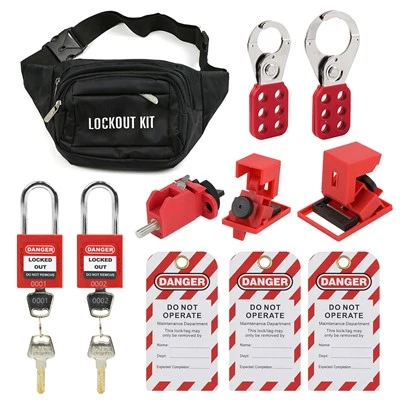
A lockout hasp is a simple but important device used in Lockout/Tagout (LOTO) procedures. It allows multiple workers to attach their personal safety padlocks to the same energy isolation point.
Lockout hasps are commonly used in industrial maintenance, electrical work, manufacturing, construction, and other environments where hazardous energy must be controlled.
What Is a Lockout Hasp?
A lockout hasp usually consists of a durable body with multiple locking holes. It is installed on a lockout point, and each authorized worker attaches their own padlock.
For example, if four workers are servicing the same machine, each worker can place a personal lock on the hasp. The equipment remains locked out until the workers have completed their work and removed their individual locks according to the site's LOTO procedure.
This makes a hasp particularly useful for group lockout applications.
Why Use a Lockout Hasp?
The main purpose of a lockout hasp is to provide individual control during group maintenance.
Common benefits include:
·Allows multiple padlocks on one isolation point
·Supports group lockout procedures
·Helps workers maintain control of their own locks
·Provides a clear visual indication that maintenance is in progress
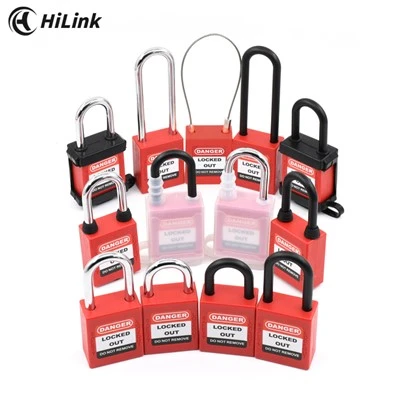
·Easy to combine with LOTO padlocks, tags, and other lockout devices
OSHA 1910.147 requires group lockout procedures to provide protection equivalent to individual lockout/tagout. Each authorized employee involved in the group lockout should apply their personal lock according to the established procedure.
Types of Lockout Hasps
Different applications may require different hasp designs.
Steel lockout hasps are widely used for general industrial applications because of their durability.
Stainless steel hasps offer better corrosion resistance and can be useful in demanding or humid environments.
Vinyl-coated hasps provide a protective coating and are commonly used where additional surface protection is desirable.
Non-conductive hasps are designed for applications where electrical insulation is an important consideration. However, the complete electrical safety procedure-not the hasp alone-determines whether an application is safe.
How Many Locks Can a Lockout Hasp Hold?
The capacity depends on the specific design. Many lockout hasps have several locking holes, allowing multiple safety padlocks to be installed.
When selecting a hasp, don't look only at the number of holes. Also consider:
·Padlock shackle diameter
·Hole size
·Hasp material
·Working environment
·Number of workers
·Available space around the isolation point
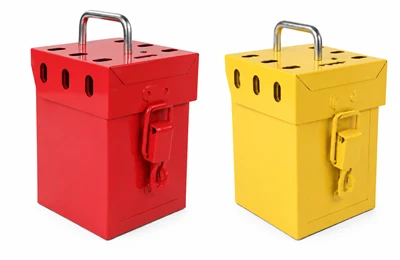
For larger teams or more complicated maintenance jobs, a lockout box may be more practical than using a large number of hasps.
Lockout Hasp vs. Regular Hasp
Although they may look similar, a lockout hasp and a regular hardware hasp have different purposes.
A regular hasp is generally designed for doors, gates, cabinets, or physical security.
A lockout hasp is designed to be part of a hazardous energy control system and is intended to work with LOTO padlocks and procedures.
Therefore, simply using a general-purpose hasp does not automatically make a lockout procedure OSHA compliant.
Lockout Hasp and OSHA
OSHA 29 CFR 1910.147 does not require one specific commercial lockout hasp design. Instead, it establishes requirements for controlling hazardous energy and for lockout/tagout devices and procedures.
Lockout devices must be durable, standardized, substantial, and identifiable. For group lockout, each authorized employee must have appropriate personal control according to the employer's energy control procedure.
Therefore, a lockout hasp should be viewed as one component of a complete LOTO system, rather than a standalone safety solution.
Final Thoughts
A lockout hasp provides a simple way for multiple workers to participate in the same lockout procedure while maintaining individual control of their personal safety locks.
Choosing the right hasp depends on the number of workers, padlock compatibility, material, working environment, and type of energy isolation point.
For simple group maintenance, a lockout hasp can be an efficient LOTO solution. For more complex operations, a lockout box or other group lockout method may be more appropriate.