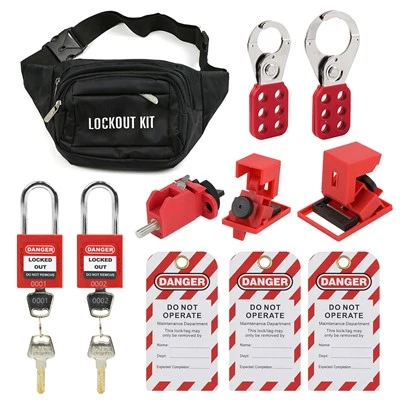
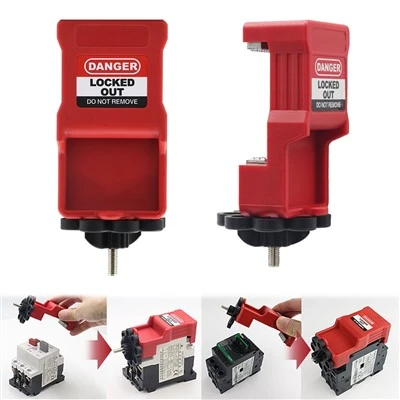
Security lock/disconnect tool kits are central to ensuring personnel safety and preventing mishandling in high-risk situations such as industrial and equipment maintenance. However, the range of tool kits available on the market varies widely in terms of materials, specifications and certification standards. Improper selection can lead to safety hazards or wasteful costs. This article provides a selection guide to avoid common pitfalls based on three dimensions: material compatibility, specification reasonableness, and certification compliance, combined with real-world examples and industry standards.
Material Selection: durability and protection to match the scene.
1.Core Component Materials
Locks and Lock Cylinder:
304/316 Stainless Steel: suitable for humid and corrosive environments (e.g. chemical workshops and coastal construction sites). Its surface oxide film is resistant to salt spray corrosion, preventing lock cylinder rust. An outdoor kit at a chemical plant, for example, uses 316 stainless steel locks that could still be opened and closed properly after 24 hours of salt spray test, extending its service life by 3 times.
Zinc alloy: Die casting process, plating (such as chrome or black plating), strength and aesthetic combination, suitable for domestic or dry industrial environment. A garage toolbox with zinc alloy locks is no deformation after daily opening and closing on impact.
High-strength engineering plastics (e.g. ABS, PA66): lightweight, shockresistant, suitable for portable toolboxes (e.g. electrician's carrying cases). A power company's portable toolbox uses a PA66 lock body; they do not break after drop testing and cost 40% less than metal.
Handle and connector: Anti-slip rubber/TPE material: improves grip comfort and reduces hand fatigue. Using a non-slip handle can reduce muscle strain by up to 60% among workers operating tools, according to one manufacturing company.
Reinforced metal structure: Heavy duty toolkits require steel or aluminum alloy handles to ensure load safety. For example, a garage kit with aluminum alloy handles can lift 50kg with one hand and no breakage after two years of continuous use.
2. Tips for avoiding Pitfallss
Avoid cheap, poor-quality plastic: Ordinary plastic locks age and become brittle. The use of cheap plastic locks at a construction site led to kits accidentally opening during transport, scattering tools and injuring people.
1. Choose zinc alloys thin plating: the thickness of the coating is not enough to peel off easily. At an electronics factory, the lock on the toolbox was rusted from plating wear and tear, affecting their locking function.
Avoid rust of carbon steel in humid environment: Common carbon steel rusts easily in humid environment. In a ship repair toolbox, the use of carbon steel locks after three months resulted in blockage of the lock cylinder jamming, increasing the cost of repair by $20,000.
ii. Specification Matching: Precise Adaptation from tool type to Usage Scenarios
1. Type and Specification Correspondence
Handheld Tools:
One-handed tools: One-handed tools with a diameter of 30-40mm can be adapted to most hand shapes to reduce grip fatigue. A 35mm diameter handle can boost employee productivity by up to 15%, according to a study.
Dualhandle tool: Start span <100mm and end span 40-50mm to avoid passive pressure on thumb. A pincer shop has reported a 70% reduction in hand injuries with dual-handle tools that meet these specifications.
Long-handled tools (e.g., saws): handle length ≥ 125mm, suitable for glove handling. A woodworking factory has seen an 80% reduction in staff error rates following the introduction of long-handled saws.
Toolboxes/Cabinets:
Lightweight toolboxes (≤5kg): Select spring latches with a load capacity of 10-20kg for ease of operation. A home repair toolbox with lightweight latches can be quickly opened and closed with one hand at a cost of up to 60% less than a heavy latch.
Heavy-duty tool cabinets (>20kg): Heavy duty tool cabinets are required to weigh more than 50kg and be evenly distributed in 2-4 locations. A tool cabinet in a garage has achieved zero deformation rate after using 4 heavy-duty latches.
instrument cases: Use cushioned latches or locks with rubber pads to reduce vibration. In a laboratory instrument case, the device failure rate was reduced by 50% with buffer latches.
2. Usage Scenarios and Functional Requirements
High-Frequency Access Scenarios:
* **Push-Type Locking Structure:** No keys or passwords are required, automatically bouncing back to lock after release. Statistics from an industrial workshop show that tool retrieval times have been reduced by 40% following the introduction of push locks.
* * _Anti-Accidental Opening Clip: _ ** Both the lock clip and lock body need to be pressed to open the lock, preventing accidental lock pick due to vibrations of operation. The construction site portable tool box adopts the design of accident proof box, which reduces the accident of falling knife by 90%.
* * _ TreasureStorage: _ **
* **Key/Combination Locks:** Restrict unauthorized access. The tool loss rate decreased to zero after the combination locks was adopted in a jewelry factory.
* **Key retention design:** Prevent unlocking due to lost keys. The utility has a key retention hole in its toolbox to prevent repair delays caused by the loss of keys.
* * _ Outside/ Bad Environment: _ **
* ** Water and dust resistance grade ≥ 44:** Prevents rainwater and dust from seeping into the lock. cylinder failure reduced by 80% after IP65 rated lock was used in toolbox at a coastal construction site. Salt spray/UV resistance test: ensure long-term weatherability. A ship repair toolbox showed no signs of ageing or cracking after 100 hours of UV testing.
3. Points to avoid
Avoid discrepancies in specifications: The electronics factory does not use enough heavy latches, causing the toolbox to buckle during transportation, damaging internal components and adding $50,000 to maintenance costs.
Choosing to operate complex locks: manufacturing companies used multi-layered combination locks, due to cumbersome operations, resulting in employees often unlocking without authorization, resulting in inefficient security controls.
Neglect of environmental adaptability: A chemical plant used common carbon steel locks in a wet workshop, and after 3 months the locks rusted cylinders, forcing the replacement of all locks, adding $100,000 to the cost.
III. Accreditation standards: dual Guarantee of compliance and security
1. Type of core accreditation
International Certifications:
ISO/IEC 17025: Laboratory competence certification to ensure reliability of test data. Toolkit manufacturers received this certification, allowing their products to pass EU tests without having to return them.
CE Certification: meets EU safety, health and environmental requirements. A company's products without CE certification were detained by EU customs, resulting in an order loss of more than 2 million yuan.
UL Certification: US safety standard certification applicable to the North American market. One toolbox maker saw a 30% increase in sales in US after gaining UL certification.
Domestic Certifications:
CCC certification: China's mandatory product certification, covering electrical safety, mechanical safety and other fields. The market regulators imposed a 500,000 yuan fine on businesses that failed to meet CCC certification.
GB/T standards: e.g. GB/T3836 (explosion-proof standard), GB/T19001 (quality management system). A chemical company's toolboxes met GB/T 3836 standard and was successfully placed on the purchase list for blast protection equipment.
2. Certification Elements and Testing Scope
Design Safety and Structural Reliability:
Material Durability Test: Toolbox lock met design requirements without wear and tear after 5000 opening and closing tests.
Extreme environmental testing: An outdoor kit was tested in temperatures between -30°C and 60°C, with locks working properly.
Prevention of abuse and misuse:
Violent Damage Test: Lock still works after being knocked and pried to prevent malicious damage.
Misoperation simulation: The toolkit automatically triggers alarms and cuts off power (for example, maintenance without power interruption) in the event of a simulated misoperation.
Usage and maintenance security:
Easy to install: The kit supports quick installation; employees can deploy independently after 10 minutes of training.
Maintenance costs: The lock features a modular design that allows for individual replacement of damaged parts, resulting in a 70% reduction in maintenance costs.
Identification, traceability and information security:
Unique serial numbers: Each kit product comes with a unique serial number for full lifecycle traceability.
Data encryption: Smart toolkit uses AES-256 encryption algorithm to prevent data leakage.
3. Key points to avoid pitfalls:
Avoid buying uncertified products: Companies buy an uncertified toolkit that malfunction during use, causing injuries to employees. The company was ordered to pay medical expenses and fined a total of 1.5 million yuan.
Choose products with incomplete certification carefully: In certain cases, only partially certified kits do not meet safety requirements and will be subject to mandatory buybacks at an additional cost of $800,000.
Ignoring certification updates: Companies failed to update certification in a timely manner, resulting in products being pulled from shelves by market regulators and losing more than 20% of their market share.
IV. INTRODUCTION Summary: Core Selection Principles and future trends
1. Core Selection Principles
Demand-oriented: clearly define usage scenario (e.g. wet conditions, high frequency channels, valuable storage) and functional requirements (e.g. prevention of accidental opening, water and dust resistance).
Compatibility priority: select matching specification (handle diameter, lock bearing capacity) according to tool type (handheld, cabinet).
Compliance bottom line: Prioritize products with international/domestic certification (e.g., CE, CCC, ISO) to ensure safe and legal compliance.
Cost-effectiveness: Balancing procurement costs with long-term maintenance costs to avoid subsequent high maintenance costs due to low-cost procurement.
2. Future trends
Intelligent upgrade: Integrated sensor and IoT technology for remote monitoring, automatic alarm, data traceability. For example, a smart kit can monitor lock's status in real time and alert you of an anomaly through an app.
Modular design: Support for rapid replacement of parts to reduce maintenance costs. One kit uses modular lock cylinder that allow individual components to be replaced in case of damage, reducing maintenance time by 80%.
Green environment protection: using recyclable materials and low energy consumption design to meet the requirements of sustainable development. One company's toolkit uses bioplastics, reducing carbon emissions by 30%.
Three key dimensions require to be considered in selecting a secure lock/disconnect kit: materials, specifications and certification. Practical case studies and industry standards identify key points and avoid pitfalls. In the future, with the development of intelligent, modular technologies, the toolkit will serve high-risk scenarios more efficiently and safely, guaranteeing safe production for enterprises.
 English
- English
- Français
- Deutsch
- 日本語
- Italiano
- Español
- Português
- русский
- Melayu
- Türkçe
- Eesti
- বাংলা
- România limbi
- O'zbek
- Malti
- فارسی
- українська
- dansk
- Svenska
- Indonesia
- Srbija jezik (latinica)
- اردو
- suomi
- Norsk
- Bai Miaowen
- slovenčina
- Nederlands
- íslenska
- bosanski
- Cymraeg
- Latviešu
- Polski
- Gaeilgenah Éireann
- Lietuvių
- Ελληνικά
- slovenščina
- عربي
- ไทย
- 한국어
- Kreyòl Ayisyen
- hrvatski
- हिंदी
- magyar
- Čeština
- Català
- עברית
- Việt Nam
- Български