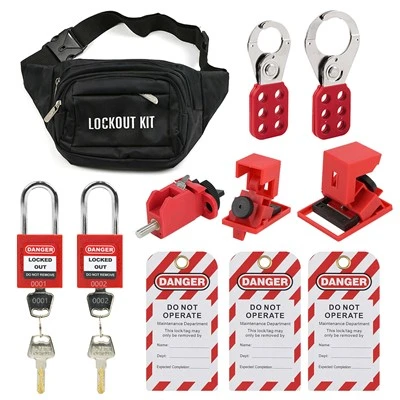
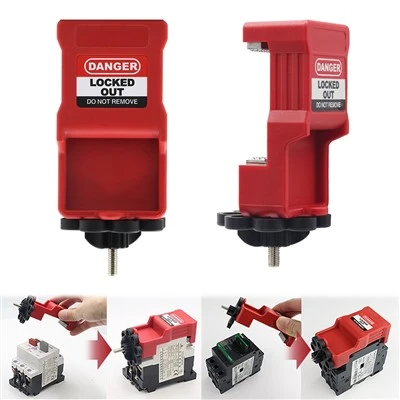
Mandatory installation of electrical safety lock labels includes:
Maintenance and repair of equipment:
Piece Replacement or Fault Repair:When replacing an electric motor, repairing circuit faults, or adjusting equipment parameters, power must be cut off, labeled, and the device prevented from accidentally starting and causing electrocution or mechanical damage.
Preventative Maintenance: Ensure that equipment is not electrified during regular cleaning, lubrication, and calibration to prevent sudden movement during maintenance.
Production Line Modification, Equipment Upgrade or reinstallation:When production line modifications, equipment upgrades or reinstallation of electrical systems, the relevant electrical switches must be locked to prevent electrical accidents due to misoperation.
Cleaning Equipment Interiors:When cleaning the inside of equipment (especially moving parts such as gears and conveyor belts), power must be cut off, tags must be locked, and equipment should not be accidentally started, causing people to clamp or crush it.
Removal of Jammed Materials and blockages:When materials become jammed inside a machine (such as conveyor belts or pipes) and manual removal is required, the equipment must be locked to prevent sudden movement of the equipment during the removal process, causing injury.
Access to equipment workspace: Any operation that requires access to the inside of equipment (such as a reactor, storage tanks or equipment cavities) must be power supply off and labeled to prevent the equipment from accidentally starting and potentially trapping or harming people.
Debugging and testing after a temporary outage: When debugging and testing equipment after a temporary outage, ensure that there is no risk of accidental startup. All relevant electrical switches must be locked and labels must be locked to prevent the device from suddenly running during debugging.
Use equipment that involves multiple sources of energy: When equipment involves multiple sources of energy sources at once, such as electricity, hydro or pneumatic, all relevant energy sources must be isolated and labelled to prevent the release of surplus energy that could lead to an accident. For example, when repairing hydraulic equipment, in addition to cutting off the power supply, hydraulic valve must be closed and the label locked.
Work in Confined Spaces: When working in an enclosed space (e.g. tank, pipe or reactor), all relevant energy sources must be cut off and labeled to prevent accidental handling by an external person from potentially harming people in an enclosed space. Someone must supervise the operation and ensure safety.
Cross-work programme: In programmes involving multiple workers performing cross-work, each worker must lock and mark his or her designated work area to prevent mishandling by others from causing an accident. For example, when repairing large equipment, electricians, fitters, welders, etc., each must lock and mark their assigned sections.
High-risk operating environment: in high-risk operating environment such as manufacturing, electricity and chemical industry, the operation of electrical equipment must strictly implement the system of lock and key to prevent serious accidents caused by accidental start of equipment.
 English
- English
- Français
- Deutsch
- 日本語
- Italiano
- Español
- Português
- русский
- Melayu
- Türkçe
- Eesti
- বাংলা
- România limbi
- O'zbek
- Malti
- فارسی
- українська
- dansk
- Svenska
- Indonesia
- Srbija jezik (latinica)
- اردو
- suomi
- Norsk
- Bai Miaowen
- slovenčina
- Nederlands
- íslenska
- bosanski
- Cymraeg
- Latviešu
- Polski
- Gaeilgenah Éireann
- Lietuvių
- Ελληνικά
- slovenščina
- عربي
- ไทย
- 한국어
- Kreyòl Ayisyen
- hrvatski
- हिंदी
- magyar
- Čeština
- Català
- עברית
- Việt Nam
- Български